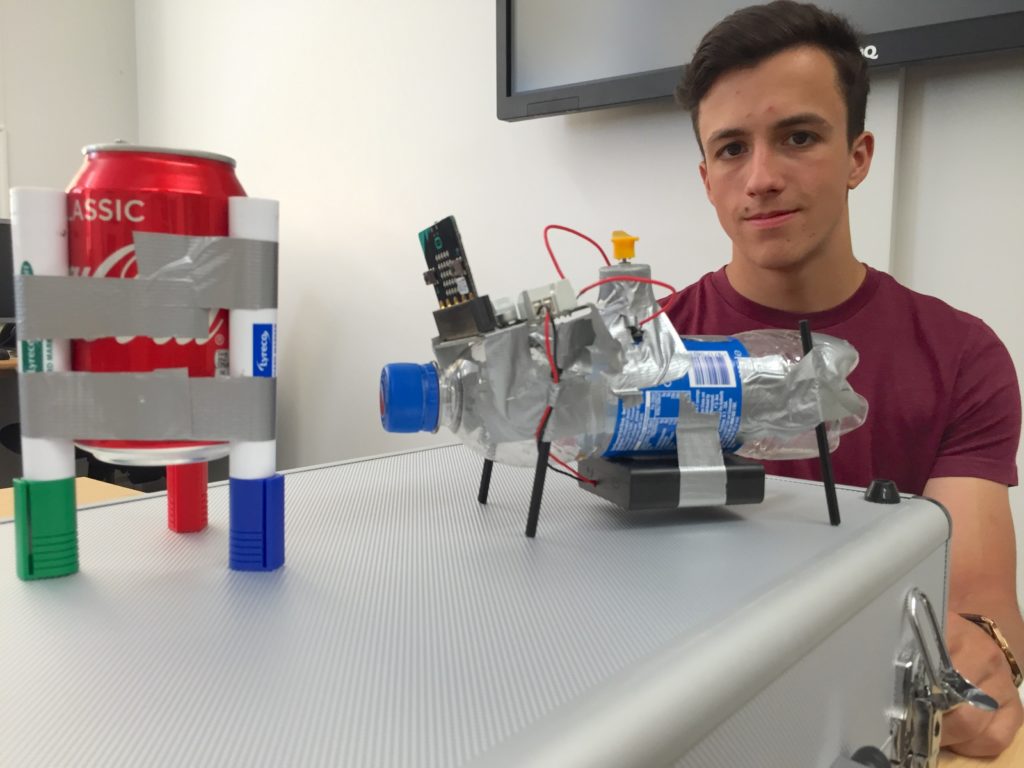
Matthew takes control of robot research project

Taken from: http://www.northampton.ac.uk/news/matthew-takes-control-of-robot-research-project/


Matthew Hole
A sixth-form student has spent the summer at the University of Northampton investigating the possibility of controlling DIY robots with a computer half the size of a credit card.
Matthew Hole, who attends Wrenn Academy in Wellingborough, has been awarded a Nuffield Research Placement – a scheme which offers sixth formers the chance to work on university research projects during the summer.
During his time at the University, Matthew used a BBC micro:bit computer  to control a junkbot – a robot made from junk, such as a drinks can, powered by a kit.
Junkbots have previously been controlled by a Raspberry Pi computer, but the University’s Associate Professor in Computing and Immersive Technologies, Dr Scott Turner, saw the potential to harness the micro:bit.
“The micro:bit has been given away free to every Year 7 pupil in the UK, so it made sense to investigate how well it could control a junkbot.
“Matthew worked incredibly hard on the research project, overcoming several problems, and was successful in harnessing the micro:bit to control a junkbot.
“He used his experience to produce an action pack, which will be available for schools to refer to so that pupils can learn how to control a junkbot with the micro:bit – so Matthew’s research has the potential to benefit thousands of young people across the UK and beyond.”
Matthew said: “The project has definitely helped me to develop my problem solving skills: I’ve learnt how to break projects down into small pieces and work on them methodically, which has been really useful,” said Matthew, who has received a bursary to carry out his work.
“To be able to work on an action pack that will be available for schools to use is also a fantastic thing to have on my CV.”

To learn more about the junkbots project contact: scott.turner@northampton.ac.uk or go to http://robotsandphysicalcomputing.blogspot.co.uk/2016/08/creating-microbit-junkbot-for-use-in.html


All opinions in this blog are the Author's and should not in any way be seen as reflecting the views of any organisation the Author has any association with.

Comments

Popular posts from this blog

Robot Software

In the previous blog posts for this 'series' "It is a good time...."  Post 1  looked at the hardware unpinning some of this positive rise in robots; Post 2  looked at social robots; Post 3  looked at a collection of small robots; Post 4 looked at further examples of small robots Robots, such as the forthcoming Buddy and JIBO, will be based some established open sourceand other technologies. Jibo will be based around various technologies including Electron and JavaScript (for more details see:  http://blog.jibo.com/2015/07/29/jibo-making-development-readily-accessible-to-all-developers/ ). Buddy is expected to be developed around tools for Unity3d, Arduino and OpenCV, and support Python, C++, C#, Java and JavaScript (for more details see http://www.roboticstrends.com/article/customize_your_buddy_companion_robot_with_this_software_development_kit ).  This post contin ues with some of the software being used with the smaller robots.  A number ...

Speech Recognition in Scratch 3 - turning Hello into Bonjour!

The Raspberry Pi Foundation recently released a programming activity Alien Language , with support Dale from Machine Learning for Kids , that is a brilliant use of Scratch 3 - Speech Recognition to control a sprite in an alien language. Do the activity, and it is very much worth doing, and it will make sense! I  would also recommend going to the  machinelearningforkids.co.uk   site anyway it is full of exciting things to do (for example loads of activities  https://machinelearningforkids.co.uk/#!/worksheets  ) . Scratch 3 has lots of extensions that are accessible through the Extension button in the Scratch 3 editor (see below) which add new fun new blocks to play with. The critical thing for this post is  Machine Learning for Kids  have created a Scratch 3 template with their own extensions for Scratch 3 within it  https://machinelearningforkids.co.uk/scratch3/ . One of which is a Speech to Text extension (see below). You must use this one ...

Escape the Maze with a VR robot - Vex VR

You don't need to buy a robot to get programming a robot, now there are a range of free and relatively simple to start with robot simulators to play with. Three examples are listed below: - Make code for Lego EV3  https://robotsandphysicalcomputing.blogspot.com/2020/05/programming-robots-virtually-3-lego-ev3.html   - i Robot simulator  https://robotsandphysicalcomputing.blogspot.com/2020/04/programming-robots-virtually-2-irobot.html - Vex robotics Vexcode VR   https://robotsandphysicalcomputing.blogspot.com/2020/04/programming-robots-virtually-1-vexcode.html   It is the last one of these ( https://www.vexrobotics.com/vexcode-vr ) that is the focus of this post and return to hit, after an earlier discussion in  https://robotsandphysicalcomputing.blogspot.com/2020/04/programming-robots-virtually-1-vexcode.html   .  Two of the nice things about the package, apart from being free, are it uses a Scratch-like programming language and it provides a ...