CBiS Education generously sent me two of their new range of robotics development kits - BinaryBots (https://www.binarybots.co.uk/makers.aspx), these are a range of cardboard based kits (so far a robot and a UFO) with electronic components for example LEDs; sensors and buzzers, depending on the kits. What makes the kits interesting though is they are designed to be controlled by either by a BBC Micro:bit or a CodeBug.
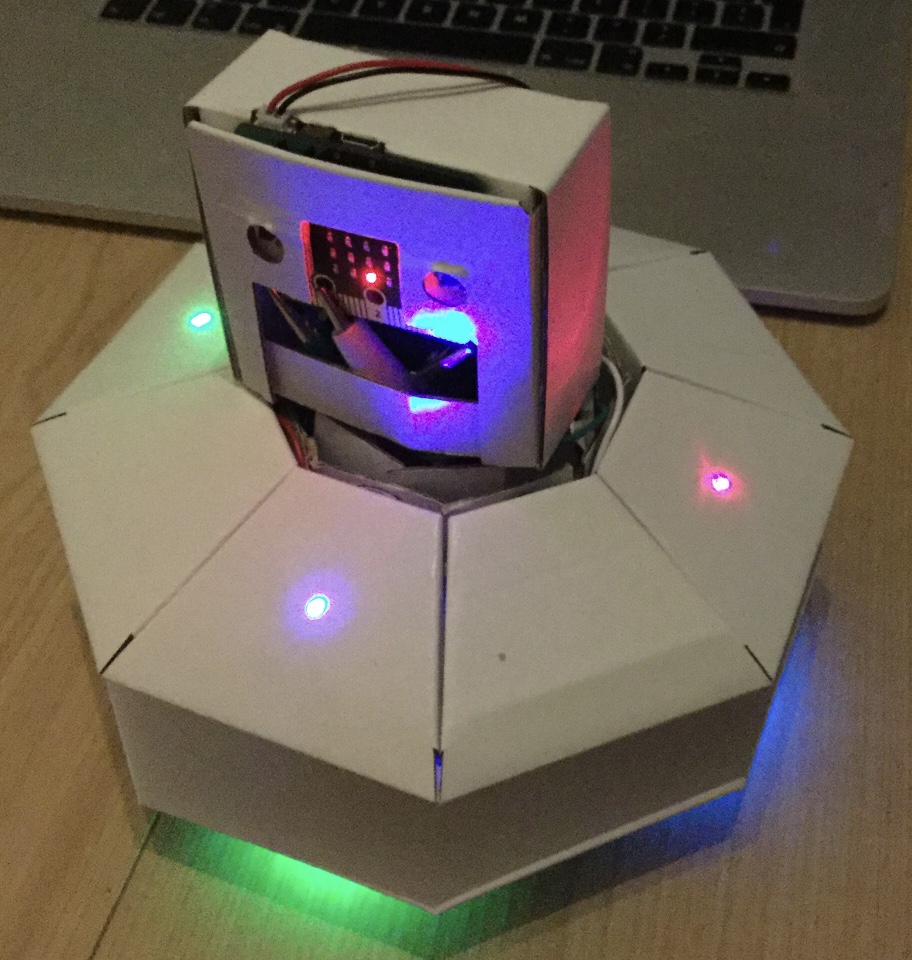
This blog documents, briefly, an initial play with the UFO kit (see below) using a Micro:Bit for control.
The UFO model came together readily, the instructions were fairly easy to follow. Personally, a feature I especially liked about the model was the LEDs being both on the top and bottom of it - increasing its usefulness. CBiS EducationThey have also provided a webpage / portal with some example projects and code.

My first project I built, was to pulse the LEDs on and off (one set of LEDs on Pin 0, the other on Pin 1). Pin 2 was connected to the buzzer, so produce a low buzz every few seconds. The code below is written using the Block Editor (https://www.microbit.co.uk/create-code)

The video below shows the LEDs pulsing. I do need to decorate the UFO though!
Looking forward to playing with it further.
Related
http://robotsandphysicalcomputing.blogspot.co.uk/2016/08/ufo-detects-light.html
All opinions in this blog are the Author's and should not in any way be seen as reflecting the views of any organisation the Author has any association with.
This blog documents, briefly, an initial play with the UFO kit (see below) using a Micro:Bit for control.
The UFO model came together readily, the instructions were fairly easy to follow. Personally, a feature I especially liked about the model was the LEDs being both on the top and bottom of it - increasing its usefulness. CBiS EducationThey have also provided a webpage / portal with some example projects and code.
My first project I built, was to pulse the LEDs on and off (one set of LEDs on Pin 0, the other on Pin 1). Pin 2 was connected to the buzzer, so produce a low buzz every few seconds. The code below is written using the Block Editor (https://www.microbit.co.uk/create-code)

The video below shows the LEDs pulsing. I do need to decorate the UFO though!
Looking forward to playing with it further.
Related
http://robotsandphysicalcomputing.blogspot.co.uk/2016/08/ufo-detects-light.html
All opinions in this blog are the Author's and should not in any way be seen as reflecting the views of any organisation the Author has any association with.
Comments
Post a Comment